Context and control across a model upgrade
Every few months brings a better AI model, the kind of program behind tools like ChatGPT, and no model we build with is ever used bare: each one sits inside an applied system, the setup of instructions, examples, checks and tools that turns a model into something good at a task. The model improves while that system stays where it was. So a real question follows: which pieces still earn their place, and which now drag the newer model down? Earlier notes made the case that a model's system does the heavy lifting. Here we ask which piece goes on lifting once the model itself changes, and we test that question on Cue, the film system we built ourselves. We write up the method so your team can repeat the exercise. The plan: set out the 2 layers we work with, compare 2 films cut from a single brief, then audit every rule, rebuild Cue, and close with the film Cue produced.
Two layers around a model
Every system we build hands its model instructions of 2 types. The first covers what no model can work out alone: who asked for the work, what the facts are, the tastes of the requester, and how the previous attempt went. We call this the context layer. The second patches the failure points a model is known to have, using rules, checklists and preset steps, each one written after we had watched a previous model fail there. This is the control layer.
On the page the 2 layers look alike, since both are just text the model reads, and either layer can hold the same knowledge. Taste offers an example: write it as reasoned observations and it works as context, or as commands to follow and it works as control. The layers do not age at the same rate, though. Context describes the work, and a change of model leaves the work itself unchanged. Control describes the habits of a single model, so a newer one can outgrow it.
Context describes the work, control describes one model's habits
One brief, two runs
To see which layer survived contact with a newer model, we gave one brief to Opus 5.5, an AI model released 11 days before, in 2 runs. Each run used a standard code agent, meaning a program where an AI writes code and executes it on a computer. The first run received only the brief plus the materials, the slice of context a first cut needs, and it built its benchmark chart of Grove against rival systems with a charting skill that came with the agent. The second run received everything the first one had, plus Cue in its existing form: 9,956 words of rules, preset steps and taste recast as rules, collected over earlier films made with previous models.
The brief called for a 60-second launch film for Grove, a product holding an up-to-date picture of your work for your code agent and checking with you whenever a decision is beyond it. The film addressed people who use AI tools at work but had never heard of Grove. Both runs worked from one shared folder holding public material: Grove's web pages, screenshots of those pages, and its demo video. No run saw any notes ahead of its first cut, only a neutral line for resuming after an interruption. Cue makes films as code: the model writes a self-playing web page, and that page is recorded to video.
3 limits shape everything below. The interruptions also froze a Cue step called directed divergence, described in an earlier note on Cue: several AI directors run competing treatments, then one is chosen and merged. In this case the system took the treatment that finished first as its base and folded in pieces from 2 others, skipping the usual judgment, which leaves that step untested here. A repeat run on the previous model, planned as a check, was dropped once the same interruptions hit, so comparing models remains a bet. With one brief and one run for each system, what follows reads 2 films rather than measuring a rate.
Two first cuts
The first 2 cuts separate mainly through pacing and how much content each one carries. Context alone, with no rules, produced a film whose screen carried 14 title lines, the last of which restated its central claim in other words, while the film with rules kept to 6. That central claim, Grove holding a picture of your world on its own, appeared as text on screen in the context-only film by 10 seconds, whereas the film with rules touched parts of the idea earlier and only showed its full closing sentence at 42 seconds. To gauge stillness, each frame was compared with the one before it: a frame counts as nearly still when its mean shift stays at 0.02 or below on a 0 to 255 brightness scale, measured on a small grayscale copy. Under that measure, nearly still frames made up 46% of the film with rules, against 7% of the context-only film.
 3 s
3 s 11 s
11 s 47 s
47 s 3 s
3 s 11 s
11 s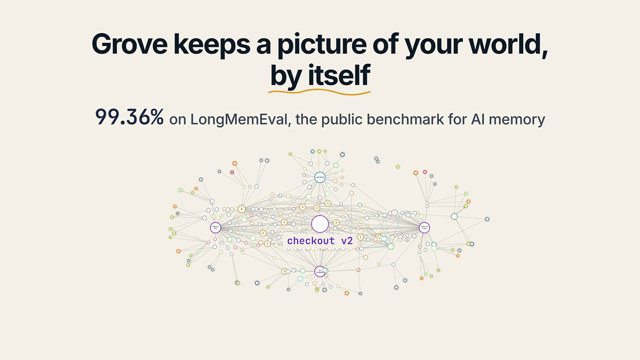 43 s
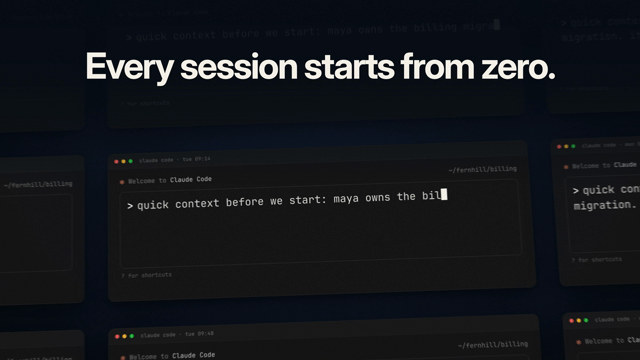
43 sThe context-only film held one thread from start to finish. It opened with someone retyping the same project context into a code agent under the line "You've explained this before", those facts drifting like the week's messages, folding into Grove's logo, becoming dots on an expanding map of the work. At 34 seconds the code agent window came back, and the agent replied using those same facts. The model had this planned by its 14th minute and held to its 13 scenes. It also managed the craft our rules existed to specify, building its own recorder, writing its own soundtrack, checking its own images, and re-recording the film to remove faint stripes that showed up in its smooth color fades.
What the rules changed
3 of the differences in the film with rules can be traced to rules we wrote ourselves. One pair, keeping every line readable on screen and limiting attention to at most 2 competing elements, was written because earlier models packed the screen and rushed past it, yet here it dragged down a model whose lines were already readable long enough. Another rule, banning counterfeits of other companies' interfaces and applied strictly in this run, cut the coding agent's window from the film, and since Grove lives in that window, the scene anchoring the other film's narrative disappeared. The revision passes, where separate AI runs graded each cut out of 10, lifted its scores from 6 across the board to between 8 and 8.5, though they graded along the direction already chosen and never offered another. These judgments rest on 2 films, not on testing each rule on its own.
The upgrade audit
Deciding what to keep meant rating the 2 films on 28 items drawn from Cue's rules, several of which bundle multiple rules into one. We name this practice the upgrade audit: every control layer item gets checked against how the new model behaved on its own, without it.
Of the elements, 11 were absorbed: the context-only film met the requirement without any help from Cue, from keeping a story continuous to clean handoffs between scenes. Another 10 were hurting, since the film that followed a rule gave up something its counterpart kept whenever it applied one. A single item stayed useful in the comparison, the one that has a film end on a number, while a second, titles without a final period, only showed its value once the context-only film went through its later revision. The remaining 5 either made no visible difference or never applied. Each finding then led to a decision: what the context-only film handled on its own stopped being written as a rule, the useful items stayed, and whenever a rule still captured the taste of the person behind the request, that knowledge moved into context.
Rebuilding Cue
Applied to Cue, the verdict shrank it from 9,956 words to 1,714. The model now receives the 4 context parts sketched in the first figure. The brief covers who is watching, what viewers should remember, the evidence, and what counts as true and private. The real materials arrive with a note saying what to draw from them: the brand itself, never the conventions of the web page that carried it. The requester's taste appears as observations with the reasons behind them. Notes on each finished cut report how it landed, since no model can watch or hear its own film the way a viewer does.
The context-only film next took 2 rounds of notes under the rebuilt Cue. In the first round the model spotted and repaired 2 overlapping labels that no note had flagged, worked 3 notes into its on-screen text, and rendered its single open choice in both versions so the requester could weigh them. The second round dropped a line from the closing card.
The exhibit
Here is that film, once both rounds of notes were in. It runs in 4K at 60 frames per second, its soundtrack written by the model as code and timed to the clock the film itself keeps, and a lighter copy plays on the page. Watch it with the sound on.
What the test showed
We split the 2 layers at the outset because we expected them to age differently, and this run gives that idea a concrete case. With one brief and one model, the real material and the brief carried the film, while rules written for older models slowed it down. Most of those rules had been absorbed or were hurting, and only 2 still helped. Our work now goes into the context, the share of the job that a newer model turns to better advantage. No new model earns our trust until an upgrade audit has gone before it. The series vocabulary gains 3 terms: the context layer, everything a model has no way of knowing by itself; the control layer, rules that push back on habits a model is already known to have; and the upgrade audit, testing every rule against what a newer model achieves when the rule is absent. The next upgrade will test our bet, that context is the half that lasts.
Contact
If these questions touch your work, we would love to hear from you.
Book a discovery call →